


From July 17 to 20, 2026, the 2026 World Artificial Intelligence Conference and the High-Level Meeting on Global AI Governance were held at the Shanghai World Expo Exhibition & Convention Center. Weltronics showcased a range of high-performance components for the robotics, AI server, and smart hardware sectors at Booth H3-A112. Among these, TE’s robotics connectivity solutions, the iC-Haus iC encoder, and SUMITOMO’s high-flex cables attracted significant attention from industry professionals.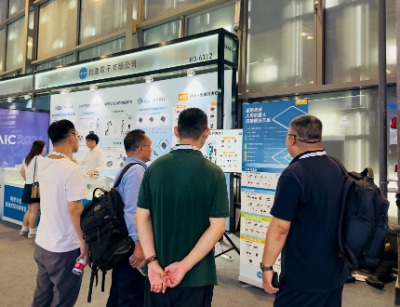
On-Site Observations:
From Robot Joints to AI Computing Hardware,Component Demand Is Becoming More Specific
During the exhibition, our engineering team engaged in in-depth discussions with industry professionals from fields such as robotics, AI servers, servo systems, and industrial automation. Based on these on-site conversations, the following three types of needs were mentioned most frequently:
First, internal wiring in robot joints remains a major challenge for miniaturization. As humanoid robot products move from the conceptual stage to prototyping, the internal space within limb joints is becoming increasingly compact, making the flex life and flexibility of cables critical factors affecting the overall reliability of the robot. The SUMITOMO high-flexibility cable exhibited by Creative Electronics—featuring a tin-plated copper alloy conductor, Teflon insulation, and a PVC outer jacket, and manufactured through processes such as twisting, bundling, stranding, and outer sheathing—is specifically designed to address this challenge.
Second, demand for component selection in AI servers and computing hardware continues to rise. As the requirements for computing density in large-model training and inference continue to increase, issues related to power management in AI servers, as well as the thermal management and reliability of high-power-density accelerator cards, are receiving greater attention. Attendees asked detailed questions about the stability of KOA’s high-precision resistors in high-frequency circuits and the durability of CHEMI-CON’s liquid-immersed aluminum electrolytic capacitors in coolant environments, with a particular focus on how to achieve higher power density and long-term reliability within limited space.
Third, equal emphasis is placed on the accuracy and ease of integration of sensors and encoders. Whether for force control and positioning of robot joints or for precise control of servo systems, the selection of sensors and encoders directly impacts the overall performance of the system. NIDEC COMPONENTS’ six-axis torque sensors feature a slim, hollow-core design optimized for installation in robotic joints; the iC-Haus magnetic off-axis absolute position encoder chip supports incremental ABZ and motor direction UVW signal outputs, enabling up to 18-bit dual-channel vernier encoding and delivering high precision within a compact package.
Connectivity Solutions:
End-to-End Coverage from Signal Transmission to Power Distribution
In robotic systems, the requirements for connectors vary depending on whether they are used for signal, data, or power transmission. TE’s robotic connectivity solutions cover sensing and communication (Mini I/O, RJ45, M8/M12, Fakra, etc.), controllers (latch-type Type C, 56G ARRAY MEZZ, DDR Socket, etc.), power systems (HK2/4-6, battery connectors, DC contactors and relays, etc.), and actuator systems (DSlim, MiniBridge, Dynamic Series, etc.), covering the full range of requirements from signal transmission to power distribution. During the exhibition, TE’s in-house engineers were on hand at the Weltronics booth to engage in technical discussions with attendees regarding specific application scenarios.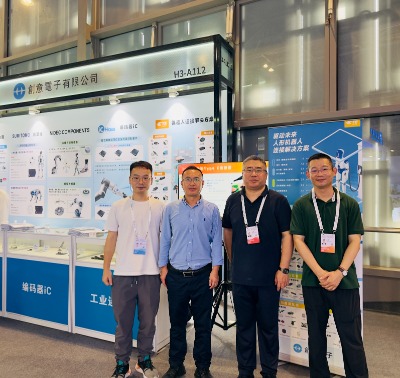
Summary
Based on discussions at the event, AI hardware is currently transitioning from the stage of “functional implementation” to that of “reliability optimization.” Whether it’s the actuator end of robotic joints or the computing power end of AI servers and accelerator cards, component selection is no longer based solely on specifications. Engineering details such as actual installation space, thermal design, and system integration are increasingly becoming key factors influencing selection decisions. Weltronics will continue to focus on the field of high-performance components, providing reliable foundational support for the AI hardware and robotics industries.